
The key to successful implementation of many government schemes lies in a few ifs.

A physics professor has applied science to suggest ways to help the country get rid of its ills and the result is a comprehensive and smart formula for social change.

A jury of farmers in Karnataka recently held a unique hearing and gave its verdict on what the country needed to do to improve farming.

India is moving towards computing the value of unpaid work done by millions of people to compensate them in some way.

Gap is hoping to find enough cows for its cotton farmers. The focus on natural farming, it says, will provide relief to cotton farmers as the high cost of fertilisers is one of the reasons for their being in debt.

According to the SEZ Act, 2005, there is no upper limit for land acquisition by state governments. It also allows acquisition of wasteland and single-crop land, putting negative impact on common property resources like land, forest and water bodies.

Magsaysay awardee Aruna Roy tells Sreelatha Menon that she is ready to chase a new dream, a School for Democracy.
The Employees Provident Fund Organisation will be seeking approval from its apex decision-making body, the Central Board of Trustees, to implement a finance ministry order to invest up to 15 percent of the fund in equity. The new pattern that was notified last year comes into force from April 2010.
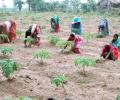
The first meeting of the newly-reconstituted Central Employment Guarantee Council last week, meant to oversee the National Rural Employment Guarantee Programme, saw two prominent members, Jean Dreze and Aruna Roy, object to various new ideas of the government, beginning with the one of using it to build Bharat Nirman Rajiv Gandhi Seva Kendras, meant to serve as offices for panchayats.
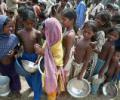
Social audit of rural jobs scheme promises to empower people with information about how they are being denied the benefits of the schemes meant for them.

The government was able to initiate crucial steps in the ministries of rural development, human resource development, home, finance and commerce, thanks to energetic ministers, but did not exactly win laurels on other fronts.

Members protest, rural ministry assures it will not be so hereafter.
Rule 4 in Section 55 of the Land Acquisition Act's Company Rules may help farmers in Dadri but is hardly a guarantee for other cultivators.
The right to food campaign, which is a collaboration of people's movements from across the country, is now on the verge of seeing its demand of a right to food become a reality.

The Institute of Cost and Works Accountants of India, the apex body to regulate the profession of cost accountants, is working out the impact of IFRS on costing principles. The ICWAI has taken this initiative at the behest of the International Federation of Accountants, the global organisation for the accountancy profession, which is for the first time addressing costing and has come out with guidelines on the impact of IFRS on costing principles.
On October 2, the government will roll out the comprehensive plan in 10 districts. The ministry has had a series of discussions with the National Institute of Rural Development, which is to be the nodal body for overseeing the convergence of all rural schemes.
Ramesh, a labourer in Toomda village near Bhopal, can't believe his luck. He earns Rs 81 a day, digging wells under the National Rural Employment Guarantee Programme, the United Progressive Alliance's flagship social welfare scheme that started in 2006.
India's anti-trust body CCI, which would ultimately replace MRTPC, is an independent body responsible for investigating mergers, market shares and conditions and the regulation of firms. Section 66 of the Competition Act deals with repealing and dissolution of the MRTPC Act, 1969. With the operationalisation of CCI, MRTPC was supposed to stop entertaining new cases and was to deal with pending cases for two years before being completely dissolved.
If the company A is located in a non-GST state, it would pay a total tax of Rs 300 (Rs 200 on finished product and Rs 100 on input), compared to Rs 200 paid by other producers in a GST state. The Centre is hoping that in such a scenario companies in GST states would lobby for introduction of the pan-India tax, which will subsume most state and Centre-level taxes.
However, unlike exports of other goods, which have been affected by the economic slowdown, the reason for fall in exports of opium is entirely different. India is the only country in the world to legally produce gum opium for export, for the pharmaceutical industry. However, exports to the US and Japan, the main importers, have been falling for the past couple of years.
 © 2026 Rediff.com - Advertise with us - Disclaimer - Privacy Policy - Sitemap - Feedback - About us - Terms of use - Grievances